


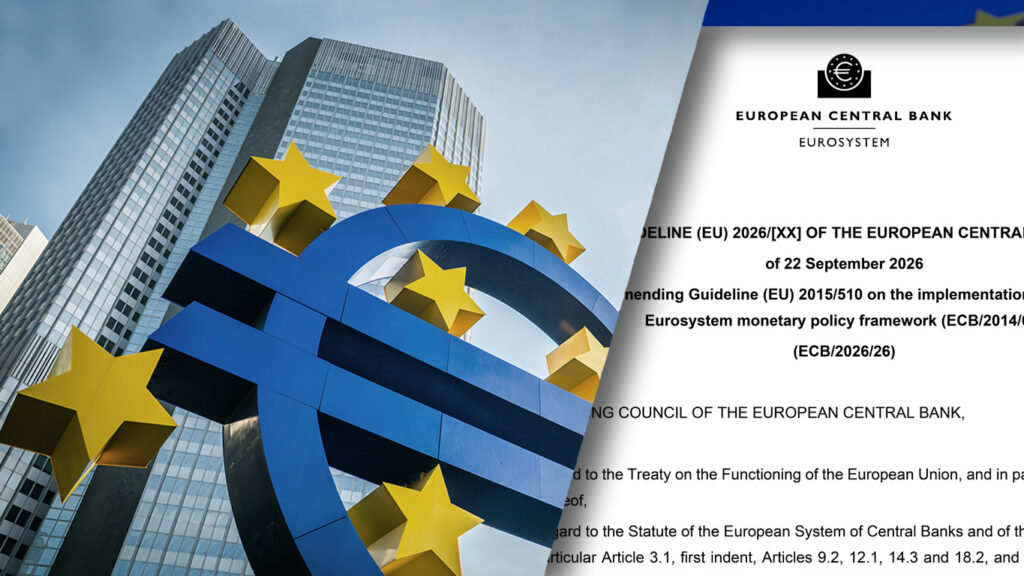
On 29 September 2026, the European Central Bank (ECB) published two guidelines revising its collateral framework and valuation haircuts: ECB/2026/26 amends the General Documentation Guideline (EU) 2015/510, and ECB/2026/27 amends the Haircut Guideline (EU) 2016/65. Both were adopted by the Governing Council on 22 September 2026. The national central banks must apply them from 30 November 2026. The changes stem from the regular review of the risk control framework, the results of which the Governing Council had already approved in November 2025.
For the securitisation market, one change stands out: the ECB will now treat asset-backed securities (ABS) according to the same principle as covered bonds. In other words, haircuts will differ depending on whether a security has been placed in the market or is mobilised as collateral by the originator itself. Placed ABS benefit from significantly lower haircuts as a result.
Key changes for securitisations
- Two separate haircut schedules: Until now, a single haircut schedule based on weighted average life (WAL) applied to all ABS. Going forward, there will be two schedules, one for placed and one for retained ABS.
- Noticeable relief for placed ABS: For CQS 1–2, haircuts fall by 2.5 to 8 percentage points across all maturities. For a WAL of three to five years, for example, the haircut drops from 7.0% to 4.0%; for ten to 15 years, from 18.0% to 10.0%.
- Retained ABS largely unchanged: For retained ABS, haircuts remain essentially at their previous level. They rise noticeably only at the long end, from 22.0% to 29.0% for a WAL of 30 years or more.
- Broader definition of “retained”: Previously, an ABS was only considered retained if the originator or a closely linked entity used more than 75% of the outstanding amount. This threshold is being removed. In future, any mobilisation by the originator or a closely linked entity will count. For all retained ABS, the WAL of the senior tranche will continue to be calculated on the assumption that issuer calls are not exercised.
- Fallback rule in case of uncertainty: If it cannot be determined in the central banks’ systems, by triparty agents or in TARGET auto-collateralisation whether an ABS is retained, the higher haircut for retained ABS applies to the entire outstanding amount.
- Rating requirements unchanged: ABS will still require at least two ratings from different ECAIs, with the second-best rule continuing to apply.
Covered bonds also in focus: second-best rule and new haircuts
The second-best rule, long applied to ABS, is now being extended to covered bonds and other private-sector collateral. Where only one rating is available, it will be lowered by one notch. For own-use covered bonds, a dedicated maturity-dependent haircut table replaces the previous flat add-ons. As before, potential maturity extensions are taken into account conservatively.
Implications for the securitisation market
The new rules send a positive signal for the market for placed securitisations. Banks holding ABS as investors will in future be able to pledge them with the central bank on considerably more favourable terms. This makes these securities more attractive on the demand side. For originators that retain their securitisations in full, however, little changes for short and medium maturities. The picture is different for transactions that are only partially retained: with the removal of the 75% threshold, they will now fall under the retained rules and thus receive higher haircuts. In addition, counterparties must clearly document the status of their securities, as otherwise the higher haircut applies automatically. A change concerning credit claims also deserves attention: their haircuts will now also depend on whether a loan is amortising, with bullet loans receiving higher haircuts.
Outlook
With less than two months to go until the 30 November 2026 deadline, there is little time to adjust collateral pools, internal systems and liquidity planning. By clearly distinguishing between placed and retained securities, the ECB is creating an incentive for genuine market placements. This is in line with the political objective of reviving the European securitisation market as part of the Savings and Investments Union. Whether this incentive translates into more placed transactions will become clear over the coming quarters.